


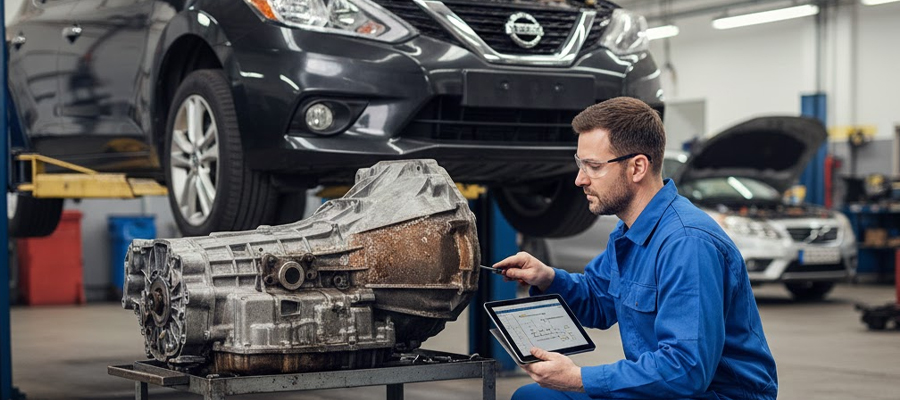
Why Nissan CVT Repairs Get Expensive When Delayed
Nissan CVT problems rarely start as major failures. They usually start small. The vehicle still drives. Nothing feels broken. Because of this, many owners keep driving and delay repairs. This delay is the main reason CVT repairs become expensive.
Cvt Systems React Differently Than Regular Transmissions
A CVT does not shift gears the way a traditional transmission does. It relies on belts, pulleys, pressure, and fluid condition. When one part starts to wear, the system adjusts. It keeps working, but not correctly. That adjustment causes stress on other parts. The longer the issue continues, the more parts are affected.
Early Cvt Symptoms Feel Easy To Ignore
Early CVT issues often feel mild. Slight hesitation. Light shuddering. RPMs rising without strong acceleration. A delay when starting from a stop. The car still moves. There is no breakdown. No loud noise. Often no warning light. Because the symptoms are small, they are ignored.
CVT Fluid Problems Usually Come First
In many cases, CVT problems begin with fluid. Fluid breaks down with time and heat. Old fluid does not protect internal parts properly. When CVT fluid degrades, pressure becomes unstable. The belt does not grip the pulleys evenly. This creates friction. Friction creates heat. Heat breaks down fluid faster. This cycle starts slowly. Driving with slipping causes wear CVT slipping does not always feel dramatic. It can feel like weak acceleration or uneven response. Inside the transmission, slipping causes the belt to rub against pulley surfaces. These surfaces are not designed to be repaired easily. Once pulley surfaces wear down, simple fixes no longer work.
Heat increases damage quickly
Heat is one of the biggest reasons CVTs fail. Small problems almost always increase operating temperature. Low fluid raises heat. Old fluid raises heat. Bearings suffer. Once heat damage occurs, repair options become limited. Small leaks cause large problems
CVT leaks often begin slowly. A seal starts to seep. Fluid loss is minimal at first. Fluid level continues to drop over time. Lower fluid means lower pressure. Lower pressure increases slipping. Heat worsens leaks. The damage spreads.
Electronic control issues add stress
Nissan CVTs rely on sensors and control modules. These components manage pressure and timing. A sensor sending incorrect data may not trigger a warning light immediately. Wear increases quietly. By the time an error appears, damage is already present.
Warning lights usually appear late
Many owners wait for a warning light before acting. In CVT systems, warning lights usually appear after damage has progressed. Warning systems react to failure conditions, not early wear. Waiting for a light delays repair.
Continued driving multiplies damage
Driving with a small CVT issue affects more than one component. One worn part puts pressure on another. The longer the vehicle is driven this way, the more internal parts are affected.
Early repairs are limited and controlled
When CVT problems are addressed early, repairs are usually limited. Fluid service. Minor seal repair. Sensor replacement. These steps restore pressure balance and reduce heat. Once internal surfaces are damaged, these repairs are no longer effective. Delayed repairs often lead to replacement. Most expensive Nissan CVT repairs happen after delays. Internal damage spreads too far. At that stage, rebuilding is difficult or not recommended. Replacement becomes the option. Contact us to get your CVT repaired.